
SHANGHAI MICROCRE OPTICS-MECH TECH CO., LTDAbout MICROCRE400-812-7833
MICROCRE · RESEARCH SCIENCE

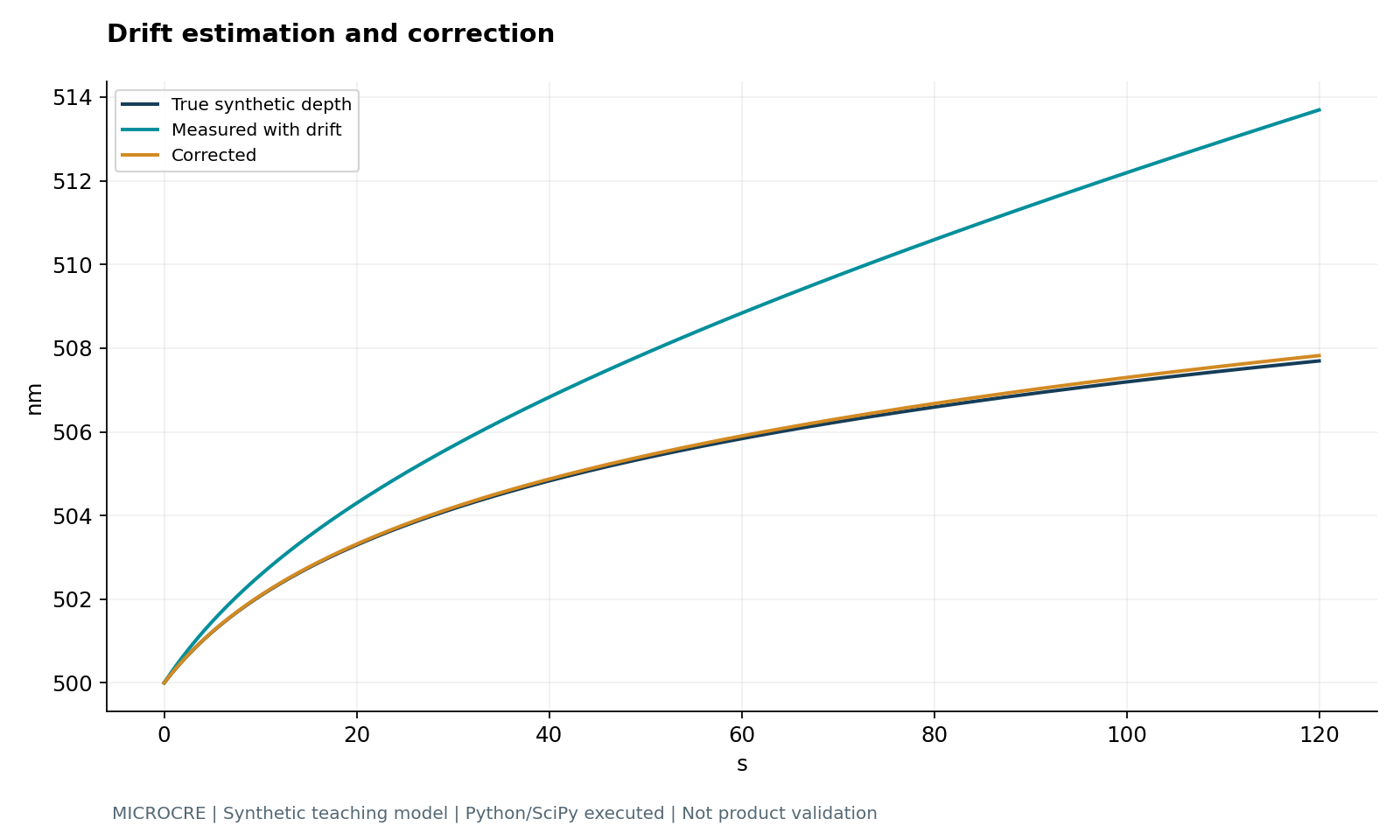
Drift estimation and correction
An educational model is not an instrument measurement. Check units, assumptions and scope.

Drift estimation and correction
Python plot for default inputs; the interactive plot uses current inputs.

Translation pending review.

Description

独立参考信号由线性漂移与确定性正弦扰动组成;最小二乘拟合漂移率后,修正另一个含对数蠕变的合成位移记录。此例说明为何不能把试样蠕变直接当成仪器漂移。

Equation

h_true=h₀+c ln(1+t/τ);h_meas=h_true+rt;r_fit=Σ(t−t̄)(d−d̄)/Σ(t−t̄)²;h_corr=h_meas−r_fit t

Input parameters

  • key

    depth

    label

    初始深度

    Unit

    nm

    Value

    500

    min

    0

    max

    1000000

    step

    any

  • key

    creep

    label

    合成蠕变系数

    Unit

    nm

    Value

    3

    min

    0

    max

    1000

    step

    any

  • key

    tau

    label

    蠕变时间尺度

    Unit

    s

    Value

    10

    min

    0.01

    max

    10000

    step

    any

  • key

    rate

    label

    已知漂移率

    Unit

    nm/s

    Value

    0.05

    min

    -10

    max

    10

    step

    any

  • key

    noise

    label

    参考扰动振幅

    Unit

    nm

    Value

    0.2

    min

    0

    max

    100

    step

    any

  • key

    duration

    label

    观察时间

    Unit

    s

    Value

    120

    min

    0.1

    max

    100000

    step

    any

Outputs

  • key

    fitted_rate

    label

    拟合漂移率

    Unit

    nm/s

  • key

    known_rate

    label

    输入漂移率

    Unit

    nm/s

  • key

    rmse_before

    label

    修正前RMSE

    Unit

    nm

  • key

    rmse_after

    label

    修正后RMSE

    Unit

    nm

Assumptions and limits

  • 参考通道不包含试样蠕变;扰动固定为观察窗内三个正弦周期。

  • 漂移在观察窗内恒定,601个等距样点。

Limitations

  • 真实热漂移可能非线性或与接触状态相关。

  • RMSE针对已知的合成真值,不是仪器准确度。

Model method

最小二乘直线斜率与位移修正;计算对已知合成真值的RMSE。

Validation

零扰动时应恢复已知漂移率,修正后误差接近浮点舍入误差。

Execution and reproduction

python

已实际运行,详见验证报告

matlab

提供可复现源码;当前环境无MATLAB/Octave,未执行

Related instruments, methods and research

Your next research question. Let’s explore.

Tell us about your material, specimen and measurement goal.

Discuss your application ↗
Find your instrument
⌕
Search products, cases, solutions, standards and literature.